Why the Newcastle farm needed a better feed handling setup
The client was a commercial poultry farm outside Newcastle in northern KwaZulu-Natal, running birds across several houses and feeding on a tight daily schedule. The old method depended too much on manual movement of feed, which meant extra labour, more spillage and slower turnarounds when the team had to top up lines before first light.
The brief was straightforward: store feed safely on site, move it where it was needed without constant handling, and keep the system easy enough for the farm crew to manage day after day. The farm also wanted better control over feed delivery during load-shedding periods, because delays in the morning can affect birds fast if the team is waiting on power or shifting feed by hand.
- Location: Newcastle, KwaZulu-Natal
- Client type: commercial poultry farm
- Main need: bulk feed storage and reliable transfer to the houses
- Secondary need: less labour and cleaner handling around the feed room
Site conditions and the constraints we worked around
Newcastle can bring hot summers, sharp rain and cool winter mornings, so the installation had to cope with weather changes and dust without becoming high maintenance. Space around the feed point was limited, and we also had to plan around live production areas so the work would not interrupt bird management or feed delivery routines.
Access to the site was another factor. Trucks had to reverse in and discharge safely, with enough room for service access later on. We checked the set-out carefully before work started, including ground levels, anchor positions and where the auger run could travel without clashing with doors, gutters or water lines. The farm wanted a practical setup, not a complicated one, and that shaped the final layout from the start.
- Weather exposure considered for sun, rain and dust
- Space planned for truck access and future maintenance
- Installation timed to avoid disturbance in active poultry houses
- Layout checked against existing services and house lines
What we supplied and installed on site
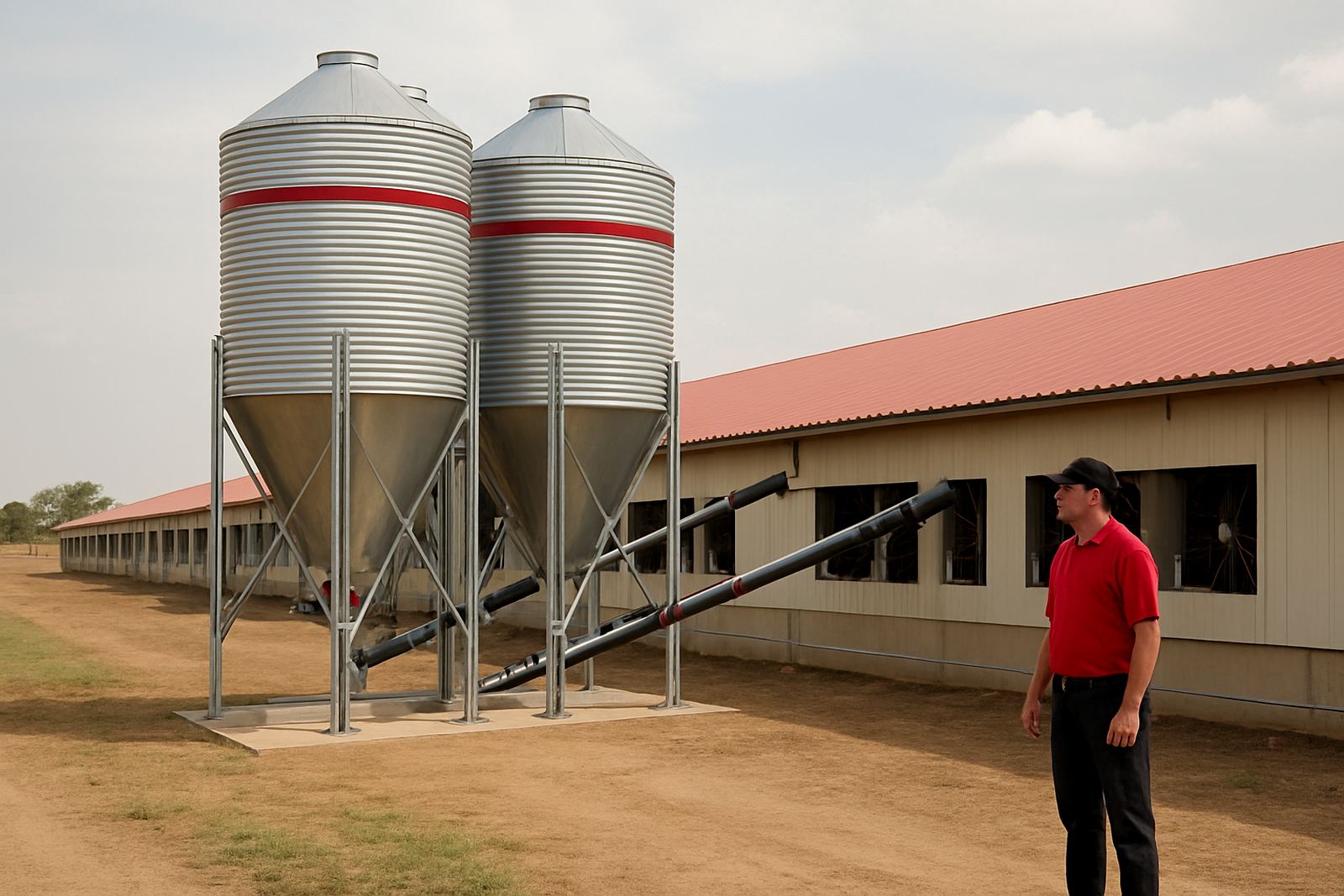
We supplied and installed a bulk feed storage silo matched to the farm’s daily intake, together with an auger transfer line to move feed to the required point efficiently. The storage vessel was fitted for safe discharge and simple cleaning around the base area, while the auger system was selected to suit the travel distance and the feed movement required on site.
The scope also included supporting steelwork, discharge points, fixings, and the practical items needed to commission the system properly. We set the installation up so the farm team could fill from a delivery truck and move feed with less manual lifting. Where needed, we adjusted the layout to suit the existing feed room and house positions, because every poultry site has its own flow and there is no sense forcing a standard layout onto a space that doesnt want it.
- Bulk feed silo sized to the farm’s intake pattern
- Auger transfer line for controlled feed movement
- Support structure, fixings and discharge hardware
- Commissioning checks for alignment, flow and safe operation
Installation timeline and handover process
The project ran over three weeks from site review to handover. Week one covered final measurements, confirming levels and marking the equipment positions. Week two focused on delivery, assembly and mounting of the silo and transfer components. Week three was used for commissioning, testing and operator handover.
During commissioning we checked feed travel, start and stop response, transfer consistency and access around the installation. We also walked the team through daily operation, cleaning points and simple checks that should be done before the first feed run of the morning. The handover needed to be practical, because poultry farms do not have time for complicated routines when the birds are waiting.
- Week 1: site measure-up and final set-out
- Week 2: equipment delivery and installation
- Week 3: testing, adjustments and handover
- Operator guidance provided before sign-off
Results for the poultry team after commissioning
Once the system was up and running, the farm had a cleaner feed handling point and far less manual movement between storage and the houses. Feed could be stored on site in greater volume, which reduced the pressure of daily top-ups and made deliveries easier to plan. The team also reported better order around the feed area, because loose bags and repeated handling were no longer part of the normal routine.
From an operations point of view, the biggest gain was time. The crew could spend more of the morning on bird checks and less on shifting feed containers around. In a poultry business that runs every day, that kind of saving matters. It also helps when electricity supply is unstable, because the farm can manage feed stock without depending on constant small deliveries.
- Faster daily feed handling
- Less manual lifting and less spillage
- Cleaner, more organised feed storage area
- Better control over stock on site
What we would do again on a similar project
If we were doing the same type of installation again, we would keep the same approach: plan the set-out properly, confirm truck access early and match the storage capacity to the actual feeding pattern rather than guessing. That saves rework and keeps the site moving. On poultry projects, the best results usually come from simple decisions made carefully at the start.
We would also keep the operator handover short and direct, with clear checks for cleaning, discharge and routine inspection. A farm team needs equipment that is easy to use after a long day, not a system that depends on one person remembering a long list of steps. That is how you keep the installation useful well after the project team has left site.
John F Marshall handles poultry equipment projects from Jet Park, Boksburg, with work across Gauteng, Mpumalanga, Limpopo, North West, Free State and KwaZulu-Natal. Our team includes site planning, equipment selection, house layouts, installation supervision, commissioning, operator training, maintenance programmes and spares supply for farms that need a proper feed-handling setup.
Key facts
| Project location | Newcastle, KwaZulu-Natal |
|---|---|
| Client type | Commercial poultry farm |
| Scope | Feed storage and auger installation |
| Timeline | 3 weeks from set-out to handover |
| Main benefit | Less manual handling and faster feed distribution |
| Service support | Commissioning, operator training and maintenance guidance |