Why the Bethal plant needed an upgrade
The client was a mid-sized poultry processor in Bethal, serving local and regional traders who needed cleaner carcass handling and more dependable output. Their existing room was doing the job, but the layout had become cramped and the old sequence forced staff to backtrack between washdown points, scalding and plucking. That slows production, makes cleaning harder and creates avoidable wear on equipment.
The brief was simple on paper but detailed in practice. The plant needed a better processing flow, easier cleaning after each shift, and equipment that could take regular use without causing downtime. We also had to work around live operations, the usual supply delays that come with rural and peri-urban sites, and the reality of local power interruptions. In Bethal, as in much of Mpumalanga, a room upgrade has to be practical in hot weather, during water interruptions and when load-shedding lands right in the middle of production.
Site constraints and planning in Bethal
We started with measurements, room counts and a walk through of the existing workflow. The building footprint left limited space for major civil changes, so the solution had to fit the room rather than forcing the room to change around it. Ceiling height, floor falls and drain positions all mattered. The client also needed the washdown area to stay compliant with hygienic processing practice, which meant fewer ledges, better splash control and stainless surfaces where water and product meet.
The biggest constraints were water management and movement through the room. Bethal can run dry at inconvenient times, so we planned for sensible hose points, quick-clean surfaces and a layout that reduces wastage. We also kept access clear for staff carrying crates and product, and made sure the equipment could be serviced without stripping half the room. A good poultry room is not only about output, it is about who can clean it at 5 am without swearing by 6, and that shaped several choices here.
- Existing room footprint retained to avoid long shutdowns
- Drain positions and floor falls checked before final equipment placement
- Water use and hose access planned for daily washdown
- Equipment arranged to keep staff movement one-way where possible
What we supplied and installed
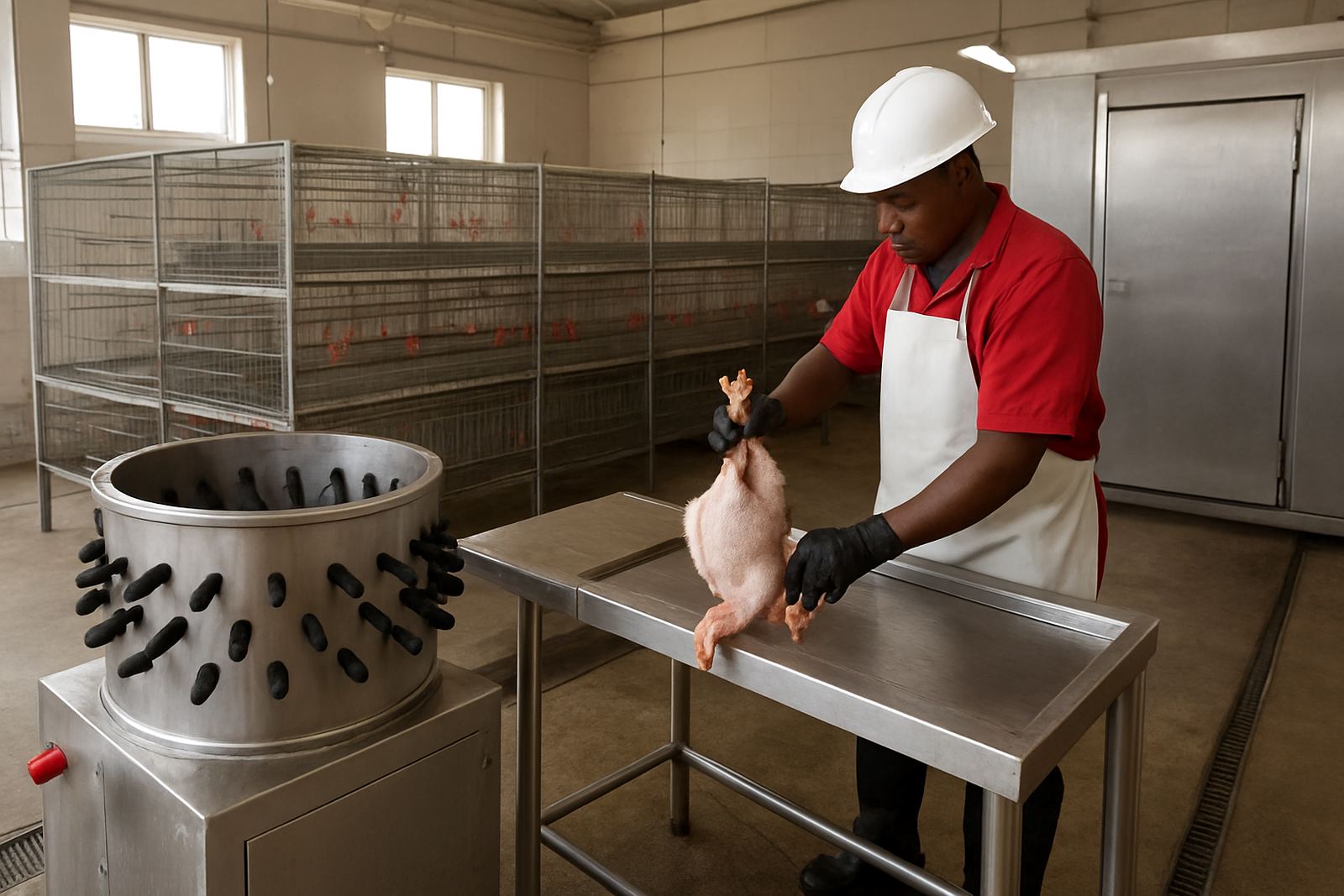
We supplied and supervised the installation of a processing room package centred on scalding, plucking and stainless workflow equipment. The scalding section was selected to give even heat transfer and steadier carcass preparation, while the plucking area was laid out for straightforward bird movement and easy cleaning between runs. Around that core, we added stainless tables, support frames and handling points that could stand up to repeated washdown and daily contact.
The stainless sections were built for a wet-room environment, with smooth surfaces and simple joints that do not trap dirt. Where useful, we specified adjustable stands and practical working heights so the team did not have to work bent over for long periods. Feed-in and discharge points were aligned to the room flow so the operator team could move product in a predictable line. This saved steps and reduced bottle necks during peak processing times.
- Scalding equipment sized for the site’s daily bird numbers
- Plucking section positioned for direct transfer from scalding
- Stainless workflow tables and support frames fitted for washdown use
- Handling points arranged to shorten movement between stages
- Layout checked for future expansion without rebuilding the room
How the work was carried out
The project ran over four weeks from final site confirmation to commissioning. Week one covered measurements, layout checks and confirmation of equipment sizes. Week two focused on fabrication preparation and procurement. Week three involved delivery, positioning and supervision of fitment on site. Week four covered testing, adjustments and operator handover. We kept communication tight throughout so the client knew what was arriving, when it would land and what would be needed from their side each day.
Our team also worked through the practicalities that often get overlooked. That meant checking access for delivery vehicles, making sure the plant team knew which parts of the room would be out of use at each stage, and planning the sequence so there was no unnecessary rework. Lerato handled operations coordination, Sibusiso kept the site steps moving, and Thabo oversaw the service side during commissioning. The result was a clean changeover with no long stop-start gaps.
Commissioning, training and day-to-day use
Once the equipment was in place, we commissioned the line and worked with the operators on the routine that would be used in the room every day. That included start-up checks, safe loading, washdown sequence, and the right way to keep the plucking and scalding areas clear between batches. Training matters because good equipment can still underperform if the crew is not using it in the right order.
Musa led the practical support on the floor, with attention to cleaning points, basic maintenance and safe handling. We also covered what to look for if output changes during the shift, which parts need regular inspection and when to call for spares or a service visit. For a plant like this, small issues grow quickly if nobody is watching them. A missed seal or blocked drain can hold up the whole room, so the handover included simple checklists and a maintenance rhythm the client could keep to without extra admin.
- Start-up and shut-down checks explained to operators
- Washdown sequence set to protect drains and stainless surfaces
- Basic fault checks covered during handover
- Maintenance timing agreed for weekly and monthly routines
Results for the Bethal processor
The upgraded room gave the client a more organised workflow, faster clean-down and a better handover between scalding, plucking and washdown. Staff no longer had to work around a crowded path or drag product across awkward corners. The stainless sections improved cleaning time and made the room easier to keep in order after a full shift. That matters in a processing room where hygiene and pace need to live together, not compete.
The plant also gained a better base for future growth. If throughput needs to increase later, the room can take added handling points and selected equipment changes without starting from scratch. The client wanted a practical improvement, not a showpiece, and that is exactly what they got. The room now runs with less friction and fewer interruptions, which is what counts when birds need to move through on time.
If we were doing the same job again, we would keep the same approach: measure carefully, plan around the existing building, and make the washdown path as simple as possible. That is the bit people underestimate. When a room is easy to clean, the rest of the operation usually behaves better too.
What this project shows about our abattoir work
This Bethal upgrade is a good example of how we handle processing room projects for poultry operations across South Africa. We do not push a standard layout into every site. Instead, we look at the building, the water supply, the staff movement and the practical limits of the town or district. A room in Bethal does not behave the same as one in KwaZulu-Natal coastal humidity or a Free State site with a long winter morning, so the detail has to be right for the place.
John F Marshall has been doing this work since 2009 from our Jet Park base in Boksburg, with poultry projects across Gauteng, Mpumalanga, Limpopo, North West, Free State and KwaZulu-Natal. For clients needing processing room fitout, equipment selection, installation supervision or training, our focus stays on usable results and support that lasts beyond commissioning. That is how you keep a plant moving after the installers have gone home.
Key facts
| Project location | Bethal, Mpumalanga |
|---|---|
| Project type | Processing room upgrade for poultry abattoir operations |
| Main equipment | Scalding, plucking, washdown and stainless workflow equipment |
| Project timeline | 4 weeks from site confirmation to commissioning |
| Key focus | Better process flow, cleaner washdown, easier maintenance |
| Support delivered | Layout guidance, installation supervision, commissioning and operator training |