Start with flock size, not equipment price
Many buyers ask whether manual or automated feeding is cheaper, but the better question is what the house must do every day. A 2 000 bird unit on a smallholding outside Middelburg has very different needs to a 40 000 bird operation running multiple houses near Standerton. If the feed must be carried in bags, tipped by hand and spread with scoop work, labour stays high and feed placement can vary from row to row.
Manual feeding still suits smaller houses, starter flocks and setups where the owner wants close control. It is simpler to understand, easier to repair and often works well where budgets are tight. Automated feeding becomes more attractive as bird numbers rise, because the time saved each day starts to matter more than the extra install cost.
In practice, buyers should compare three things: daily labour, feed consistency and room for future expansion. If you plan to add a second house within two years, it may be worth laying out the site for automated lines now so you do not have to rebuild later.
Where manual feeding still makes sense
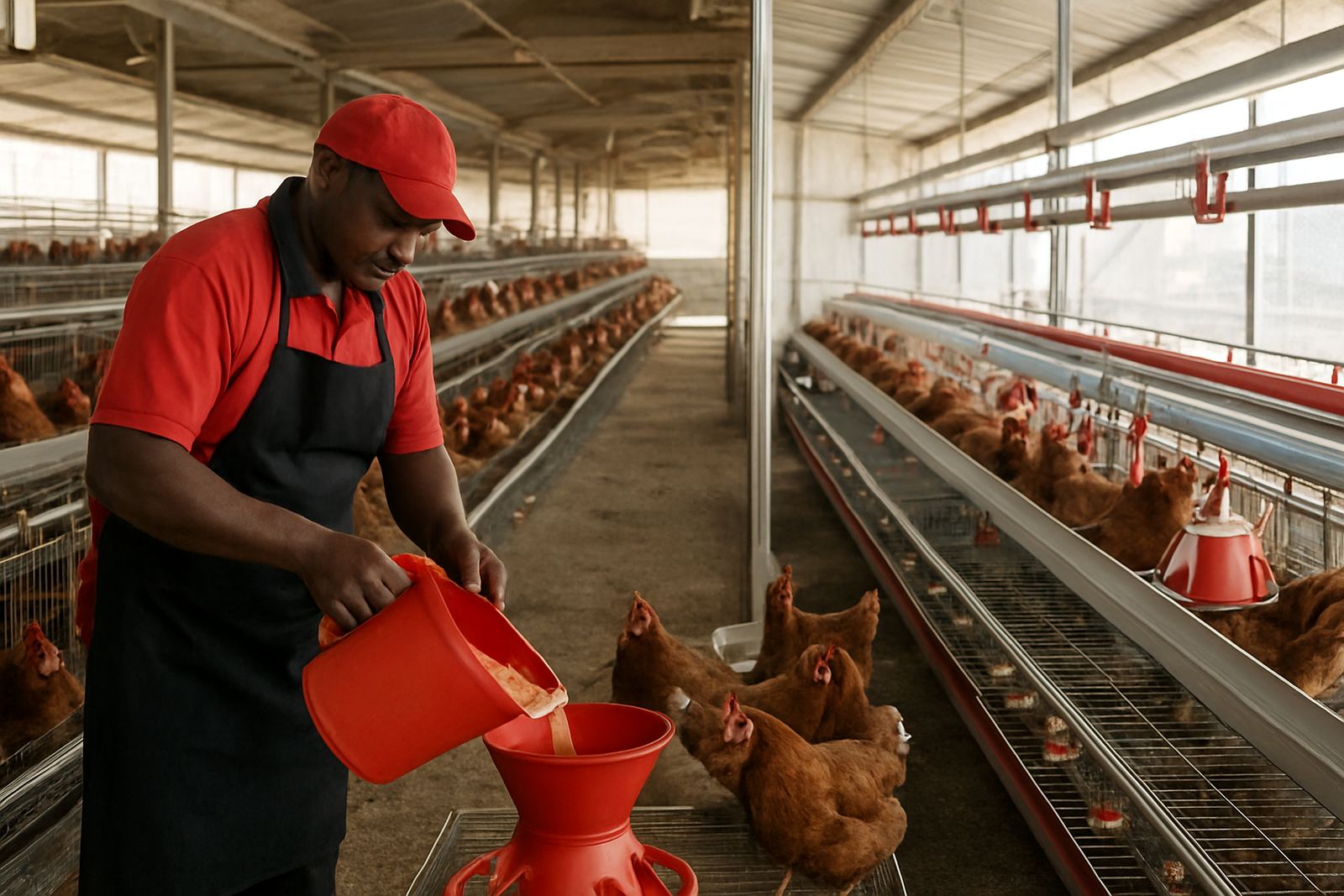
Manual feeding is not old fashioned. It can be a practical choice where the flock is small, the house is short, or labour is already on site for other tasks like cleaning and egg collection. In parts of Limpopo and the North West, some growers prefer a manual system because the houses are spread apart and they want fewer moving parts.
It also helps where power supply is uncertain. Load-shedding can interrupt motors, controls and timed delivery if the system is not backed up properly. A manual setup does not remove the need for planning, but it reduces the number of components that can stop a feeding cycle. That matters on farms where the generator is already carrying lights, ventilation and water supply.
- Lower upfront cost than a fully automated line
- Simple training for new staff members
- Useful in small houses and trial flocks
- Less dependence on electrical controls
For growers who process birds in small batches or keep replacement stock nearby, manual feeding can still be the easiest route. The key is to keep walkways clear, bins dry and feed handling organised, otherwise labour savings disappear quickly.
What automated feeding changes in the house
Automated feeding reduces the number of times people have to enter the house and move feed by hand. Depending on the layout, feed can be transported from storage and delivered through pan lines or chain systems to several rows at once. That improves consistency, especially when birds need the same access across the full house length.
With a good layout, automated feeding can also help reduce feed waste. Birds are less likely to scatter feed if delivery is even and troughs or pans are set at the correct height. This is important in broiler and layer systems where a few percent of waste adds up over a year. On larger projects, those savings often matter more than the headline equipment price.
Automated systems do need planning. You need enough feed storage, reliable motors, safe control panels and a maintenance routine that does not get ignored. If a chain slows down or a hopper runs low, the birds feel it fast. That is why installation supervision, commissioning and operator training are as important as the hardware itself.
- More even feed distribution across the house
- Less daily labour and fewer handling errors
- Better fit for larger flocks and expansion plans
- Requires maintenance, power planning and trained operators
Labour cost is only part of the story
When buyers compare manual and automated feeding, they often calculate only the purchase price. That misses the ongoing cost of labour. If two staff members spend several hours each day carrying feed, opening bags and checking distribution, those wages become part of the system cost. In Gauteng and KwaZulu-Natal, where labour availability can change quickly, that may influence the decision as much as the equipment itself.
Automated feeding can free staff for cleaning, flock checks and record keeping. It does not remove labour, but it changes how that labour is used. For farms running several houses, that shift can improve timing and reduce mistakes during busy periods. It also lowers the risk of one tired worker doing the same task too quickly and missing a problem.
There is another point buyers sometimes overlook: the cost of inconsistency. Uneven feeding can affect bird growth, egg output and flock behaviour. A small gap in one section of the house might not seem serious on day one, but over a full cycle it can show up in weight variation and extra sorting later.
How power, water and layout affect the decision
South African conditions matter. In hotter areas of Mpumalanga and Limpopo, ventilation and water systems already work hard, so feeding equipment must fit around the rest of the house. If the house has poor access or cramped service corridors, manual feeding may be easier at first but harder to scale. If the site has a clean electrical supply and space for proper feed lines, automation starts to look stronger.
Water and feed delivery should be planned together because birds do not eat well if drinker placement creates congestion. In a new house, it often makes sense to map feeder and drinker lines at the same time, then check turning space, hopper positions and access for maintenance. Municipal approvals and fire access routes can also influence where stores and control rooms are placed.
For coastal or humid areas, such as parts of KwaZulu-Natal, keep feed storage dry and allow for corrosion resistant supports where needed. Moisture can spoil feed, damage controls and shorten component life if the installation is not thought through properly.
A local example: scaling a poultry site near Boksburg
A grower starting with two houses near Boksburg might begin with manual feeding in the first unit and automated feeding in the second. That sounds mixed, but it can be a sensible way to compare labour use and bird performance on the same site. The owner sees exactly how many staff hours are lost to hand feeding and whether the second house gives tighter control.
If expansion is likely, the smarter move is often to prepare the site layout early. That means allowing for storage, feed delivery routes, maintenance access and future house spacing. Once concrete slabs and service points are in place, changing from manual to automated later becomes much simpler. If you wait too long, you end up paying twice for some parts of the job.
For a buyer who wants to grow in stages, the best answer is not always one system for every house. It may be a phased plan that starts practical and ends efficient, with each step tied to flock numbers and staffing.
What to ask before you choose
Before you commit, ask the supplier to explain how the feeding system will work on your specific site. The answer should cover installation, spares, training and maintenance, not just the equipment list. A good supplier will also ask about your flock type, house size, power backup and whether you expect to add more houses later.
- How many birds per house are you planning for now and in three years?
- Will staff have time for hand feeding every day, or is labour already stretched?
- What happens to the system during load-shedding or generator changeover?
- Can the layout be expanded without tearing out the first install?
- Are spares and service support available close to your area?
The right feeding choice is not only about automation. It is about matching labour, consistency and scale to a working farm. That is where the savings show up, and where the stress stays down.