Why egg rooms need more than open floor space
Too many egg rooms start with stacks on the floor and a few odd shelves against the wall. That works for a while, then trays get mixed with empty crates, packed eggs get pushed too close to washing points, and staff spend half the shift moving things around instead of handling product.
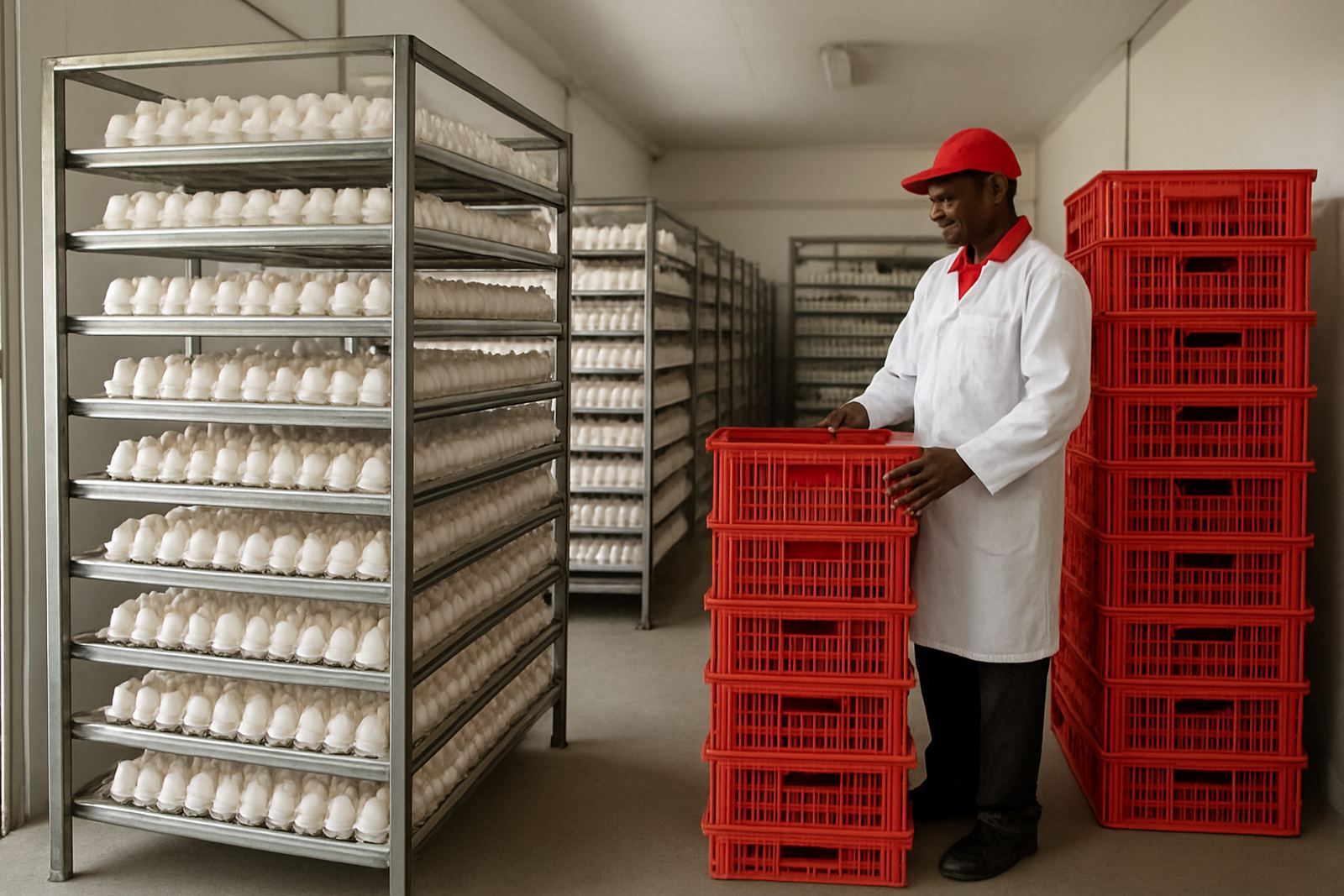
Proper racking gives each item a place and keeps movement simple. Trays, crates, labels, cartons and packing materials can be separated by stage, so fresh eggs do not sit near returned crates or dirty outer packaging. It also makes cleaning easier, which matters in hot weather and in rooms that stay busy during load-shedding when work has to be done in shorter blocks.
For farms and packrooms in Gauteng, Mpumalanga and Limpopo, where dust and temperature swings can be an issue, a neat racking layout also helps protect stock from knocks, moisture and unnecessary handling.
Design the racking around how eggs move through the room
Before buying anything, map the flow. Where do trays come in, where are empty crates stored, where do packed eggs wait for dispatch, and where do staff turn around with trolleys or hand carts? The answer should guide the racking layout, not the other way round.
A practical egg room usually needs separate zones for intake, short-term storage, packing and dispatch. If these zones overlap, the room becomes cramped very quickly. Keep the most-used items at waist height where possible, and leave enough floor clearance for sweeping, mop cleaning and checking for broken eggs.
- Store empty trays close to the intake point to cut walking distance.
- Keep packed eggs near the dispatch side, but away from direct sun or heat from windows.
- Use lower bays for heavier crates and higher bays for lighter cartons or spare materials.
- Allow space for a trolley or pallet jack if the room uses one.
In a small operation near Rustenburg, this kind of layout can be the difference between one person keeping up and two people still chasing stock at the end of the day.
Choose rack sizes that suit trays, crates and cartons
Egg room racking should fit the real sizes used on site. Standard poultry trays, crate bundles and carton stock need different shelf heights, so a one-size-fits-all shelf usually wastes space. Ask what is being stored most often and size the bays around that first.
For most sites, steel racking with easy-to-clean open sections is a practical choice. Closed cupboards trap dust and make it harder to see what is low or short on stock. Adjustable shelves are useful where pack sizes change through the year, or where the site wants to keep some bays for day-to-day use and others for reserve stock.
For humid coastal areas or wash-down rooms, the finish matters too. If the racking is exposed to moisture, cleaning spray or damp air, choose a finish that will not rust after a few months. Around KZN, that detail saves a lot of later trouble and rework.
- Measure the tray stack height before ordering any shelving.
- Leave a small gap above each stack so stock can be lifted out without catching.
- Do not overfill bays, because packed eggs can be damaged when staff pull product from the back.
- Mark each shelf or section clearly for trays, crates, cartons or returns.
Keep hygiene simple with cleanable, numbered storage
An egg room must stay easy to clean. Dust, feather debris and broken shells build up fast if the racking has too many tight corners or hidden edges. Straight frames, open sides and smooth surfaces make daily cleaning simpler and quicker. That matters when the site is operating through municipal water limits or running short on time after a power interruption.
Numbered bays help staff put items back in the same place every time. This sounds small, but it prevents mix-ups between new trays and returned trays, or between stock ready for collection and stock that still needs packing. It also helps supervisors check stock levels at a glance.
In practice, a well numbered room cuts confusion for new staff, and it is easier to train temporary workers too. If the room changes shift by shift, the labels still do the work. On busy sites, that is often where the saving is.
Plan for handling, not just storage
Egg room racking is not only about where stock sits. It must support the way people move. Staff should not twist around full crates, reach over packed stock or lift trays from above shoulder height all day. That creates strain and leads to mistakes, especially in a room with a small team.
The best layout keeps the heaviest items between knee and chest height. Empty crates can go lower if they are light enough to lift safely. Packed eggs should sit where they can be checked, labelled and moved with the least handling possible. If the room uses trolleys, the aisle width must allow turning without bumping the rack ends.
- Keep walkways clear for one person carrying stock and another passing behind them.
- Use end stops or barriers where crates could slip off shelves.
- Leave room for cleaning buckets, labels and small tools at one end of the room.
- Separate dirty returns from clean packed stock at all times.
That kind of planning is often missed when a site expands quickly, but it is easier to build in from the start than fix later.
A practical example from a Gauteng packing room
A medium poultry operation in the east of Gauteng had a small egg room that filled up by mid-morning. Trays were stored along one wall, empty crates were stacked on the floor, and packed eggs were waiting in cartons near the doorway. Staff kept moving the same items twice, and broken eggs became a regular complaint.
After the room was reorganised with labelled rack bays, the trays were moved to intake height, crates were kept in a separate section, and packed stock was stored close to dispatch. The room did not get bigger, but the handling improved straight away. Staff spent less time searching, cleaning took less time, and stock checks became easier at the end of each shift.
That sort of change is common. The building stays the same, but the working pattern becomes much simpler once the racking matches the process. It is not fancy, just practical.
When to upgrade and what to ask for
If your egg room is already crowded, the signs are usually clear. Staff keep moving trays from place to place, the floor is never fully clear, and returns are mixing with packed product. At that stage, more shelves alone may not be the answer. The room may need a better layout, stronger frames, or a full rethink of the storage zones.
When planning an upgrade, ask for racking that suits the exact tray and crate sizes used on site, allows simple cleaning, and holds up in local conditions. If the room is tied into a larger poultry project, it is worth linking the storage design to the house layout, processing flow and dispatch area so the whole site works together.
John F Marshall supplies poultry equipment and turnkey project support from Jet Park, Boksburg, with work across Gauteng, Mpumalanga, Limpopo, North West, Free State and KwaZulu-Natal. For egg rooms that need proper storage and handling, the right racking setup can save time every day, not just when the room is new.