Why feeder height changes flock performance
Feeder height is not a small setting. In a broiler house or layer house, even 20 to 30 mm can change how birds stand, peck and move around the line. When the feeder is at the right level, birds eat with a natural head position and spend less time pushing, crowding or flicking feed onto the floor.
In South African conditions, where summer heat, dust and load-shedding can already upset house conditions, it helps to keep feed access simple. Birds that can reach feed comfortably are usually calmer and more even in body condition. That means less wastage, fewer weak spots in the flock and better use of every bag of feed.
Start with the birds, not the equipment
The feeder should suit the age and size of the birds first. A chick, grower and point-of-lay bird all need different settings. If you run laying hens, the feeder lip should sit close to the birds back line, not up near the breast or down near the litter. For heavier birds, a little more clearance may be needed, but the principle stays the same: birds must reach feed without stretching.
- Check the average bird size before adjusting the line.
- Walk the house and watch the smallest birds feed as well as the biggest.
- Look for feed spilling into the litter under the line.
- Watch whether birds are standing too far on tiptoe or reaching awkwardly.
A simple field check for correct feeder height
A quick field check is often enough to spot a problem. Stand at bird level and look across the feeder line. The birds should be able to peck comfortably with their heads slightly down and their bodies balanced. If they need to stretch too high, intake drops. If they can scratch feed out too easily, the line is too low.
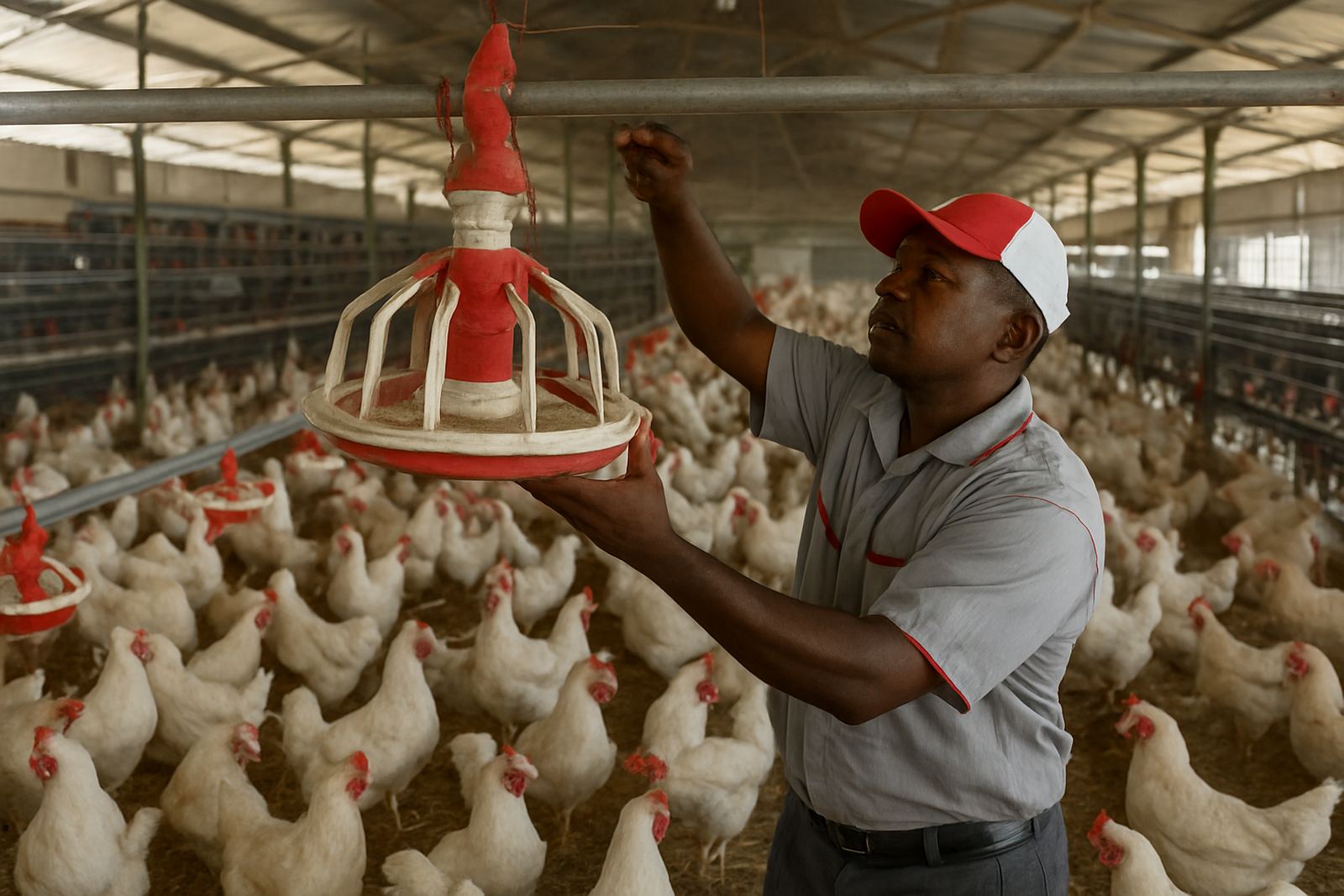
Use the birds themselves as the guide. The feeder edge should generally sit near the bird back line for grown stock, while allowing enough clearance so feed stays in the pan or tray. In houses with uneven floors, hang points or chains, check each line end to end because a small slope can create a noticeable difference down the row.
- Observe the line during first light when birds are active.
- Check both ends of each row, not only the middle.
- Confirm that all pans or trough sections hang at the same level.
- Make sure feeder adjustment points lock properly and do not slip.
Practical adjustment steps for South African poultry houses
Adjusting feeder height should be part of your normal house routine, especially after a batch move, a grading cycle or a clean-out. In many houses around Gauteng, Mpumalanga and KwaZulu-Natal, workers find that moisture, bedding movement and daily handling cause the line to shift over time. A small change today can save feed tomorrow.
Use a measured approach. Lower or raise the line in small steps, then watch the flock for at least one full feeding period. If the birds start feeding more evenly and there is less feed below the line, you are moving in the right direction. If crowding increases, or the birds are turning feed out while pecking, adjust again.
- Switch off the line before adjusting chain or hanging height.
- Work in small increments, then re-check after the birds settle.
- Record the setting used for each age group.
- Inspect for wear on hooks, pulleys and hanging points.
Common mistakes that waste feed
The most common problem is running the feeder too low for too long. Birds scratch feed onto the litter, then step through it and it becomes waste. The next mistake is setting all houses the same way regardless of bird size. A brooder house and a mature layer house are not the same, and the feeder setting should not be treated as one fixed number.
Another issue is ignoring house conditions. If the floor is uneven, litter depth changes or the line has been bumped during cleaning, the feeder height can drift. In coastal areas, where humidity can affect litter and metal parts, it is worth checking the line more often. A small bit of rust or a sticky hanger can throw the setting off over time.
Feeder height checklist for daily rounds
Keep this as part of the morning house walk. It takes only a few minutes and helps catch problems before they become expensive. This is especially useful in houses with automatic systems, where a fault can affect a full house before anyone notices.
- Birds can reach feed without stretching hard.
- Feed is staying inside the pan or trough.
- No section of the line is hanging lower than the rest.
- Hangers, chains and adjustment points are secure.
- Smaller birds are feeding as easily as larger birds.
- There is no build-up of feed in the litter under the line.
If two or more of these items are not right, the feeder height needs attention. Do not wait for feed bills or poor bird condition to show the problem.
When to review your feeder settings
Review feeder height whenever the flock changes stage, after equipment maintenance, after a power interruption and after any major house cleaning. In projects across Free State, Limpopo and the North West, we often see settings drift after repairs or extensions because the line has been re-hung slightly differently. That small change can affect access across the whole house.
If you are planning a new house, an upgrade or a turn-key poultry project, the feeder system should be matched to the birds, the house layout and the way staff will service it each day. Good planning makes the daily setting easier, and it keeps the flock feeding evenly from start to finish.