What these ventilation fans do in a poultry house
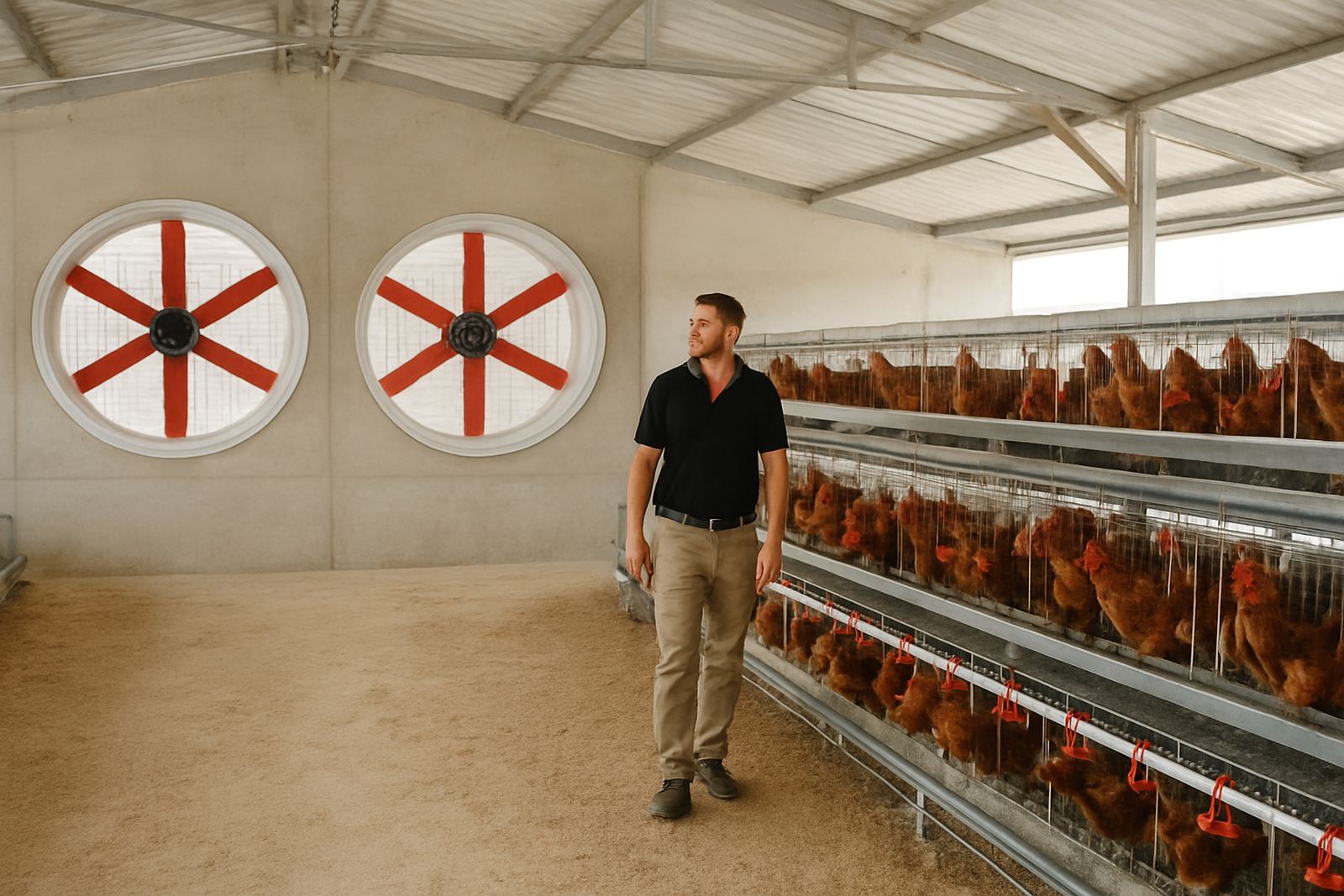
Ventilation fans move stale air out and draw fresh air through the house so temperature, humidity, odour and ammonia stay easier to manage. In a broiler or layer house, that matters from chick placement right through to grow-out, because dead air pockets quickly become a problem when stocking density is high.
We supply fans for extraction and circulation, depending on the house layout and the result you need. Extraction fans are used to pull hot, moist air out of the house. Circulation fans are used to move air across birds, improve mixing and reduce still spots along long sidewalls or in houses with uneven airflow.
- Suitable for broiler houses, layer houses and rearing houses
- Works with tunnel ventilation, cross ventilation or mixed systems
- Helps manage heat stress during summer and late afternoon temperature spikes
- Useful in houses near the coast where humidity stays high
Sizes, airflow ranges and build options
Ventilation fans are normally selected by diameter, airflow rate and motor size. Common poultry house sizes include 500 mm, 630 mm, 900 mm and 1 200 mm units, with higher capacity models used in longer houses or where tunnel ventilation is required. The right choice depends on house length, bird type, stocking density, sidewall openings and how many fans will run together.
Typical airflow ranges start at about 4 000 m3/h for smaller circulation units and can run to 40 000 m3/h or more for larger extraction fans, depending on blade design and motor load. Most units are available as direct-drive or belt-drive types. Belt-drive fans are often easier to match to varying duty cycles, while direct-drive units need less routine adjustment.
- Diameters: 500 mm, 630 mm, 900 mm, 1 200 mm
- Airflow: approx. 4 000 m3/h to 40 000 m3/h plus
- Drive options: direct-drive or belt-drive
- Mounting: wall, end wall, sidewall or gable positions
Where ventilation fans suit best
These fans suit poultry houses that need dependable air movement through summer heat, winter damp and the daily rise in moisture from drinking, manure and bird respiration. They are also useful in houses with longer spans where natural air movement is not enough, or in sites where prevailing winds change direction and airflow becomes uneven.
In Gauteng and North West, the main issue is usually heat build-up and dust. In Mpumalanga and Limpopo, the challenge can be high daytime temperatures with nights that do not cool quickly enough. In KwaZulu-Natal and other humid areas, fans help shift moist air before it settles on litter and steelwork. If you are running a turnover house or expanding an existing unit, fan placement should be planned with the full internal layout, not just the wall opening size.
- Layer houses with steady year-round occupancy
- Broiler houses with variable stocking and turn-around cleaning
- Rearing houses needing controlled airflow for younger birds
- Processing rooms and service areas needing extraction support
Installation needs, power supply and controls
Correct installation makes a big difference to performance. Fans must be mounted square, sealed properly and matched to the inlet system so they pull air through the house instead of short-circuiting around the edges. A poorly sealed opening can waste power and leave hot spots near the roof line or at the back of the house.
Most poultry fans run on standard single-phase or three-phase electrical supply, depending on size and total load. For larger projects, the electrical design should allow for start-up current, cable length and changeover during load-shedding. Where backup generation is part of the site plan, the starting load of all grouped fans must be checked carefully so the generator does not trip when several units come on at once.
For houses using automatic control, fans are usually linked to thermostats, timers or environmental controllers. This allows staged operation, so smaller units run first and larger extraction fans cut in only when the house needs more air movement.
Care, cleaning and servicing between cycles
Fans work better when kept clean. Dust on blades, belts, guards and motor housings reduces airflow and raises running temperature. In poultry houses, a simple cleaning routine at every wash-down helps prevent build-up and keeps bearings and belts in better condition.
We advise checking fan alignment, belt tension, grille condition and motor noise at each cycle change. If a fan starts vibrating or the airflow sounds uneven, it should be inspected before the next placement. Coastal sites may need more frequent checks because humidity and salt air can shorten the life of fasteners and exposed metal parts.
- Wash blades and guards after depopulation
- Check belts for cracking, glazing or slack
- Inspect bearings, mounting bolts and isolation pads
- Keep spare belts and critical motor parts on site
What to check before ordering fans
Before ordering, measure the house length, width and ceiling height, then note the number of birds, ventilation pattern and any existing openings. It also helps to record whether the building is brick, panel, steel or timber framed, because that affects mounting and sealing. If you already have a controller in place, check the available outputs and whether the new fans need relays or extra protection.
The most common mistakes are choosing fans only by diameter, not by airflow, and forgetting to account for motor size, electrical supply or backup power. We recommend checking the full project plan, including inlet positions, louvres, shutters and the way the air should travel through the house. For new builds and expansion upgrades, that prevents rework later on and keeps the installation cleaner.
- House dimensions and bird type
- Required airflow and intended fan pattern
- Power supply available on site
- Mounting surface and opening size
- Whether the fan is for extraction or circulation
Poultry project support across South Africa
John F Marshall supplies ventilation fans as part of poultry equipment projects and stand-alone upgrades. From our Jet Park base in Boksburg, we support sites in Gauteng, Mpumalanga, Limpopo, North West, Free State and KwaZulu-Natal, with practical help on site planning, equipment selection, layouts, installation supervision and commissioning.
If you are fitting out a new house or replacing old fans, we can help with the full order list, including spares and maintenance planning. That is often the difference between a house that only runs on paper and one that keeps moving air properly once birds are inside.
Key facts
| Product type | Extraction and circulation fans for poultry houses |
|---|---|
| Common diameters | 500 mm, 630 mm, 900 mm, 1 200 mm |
| Airflow range | About 4 000 m3/h to 40 000 m3/h plus |
| Drive types | Direct-drive or belt-drive |
| Power supply | Single-phase or three-phase, depending on size |
| Typical use | Poultry houses, processing rooms and service areas |