Gas brooders for controlled chick heat
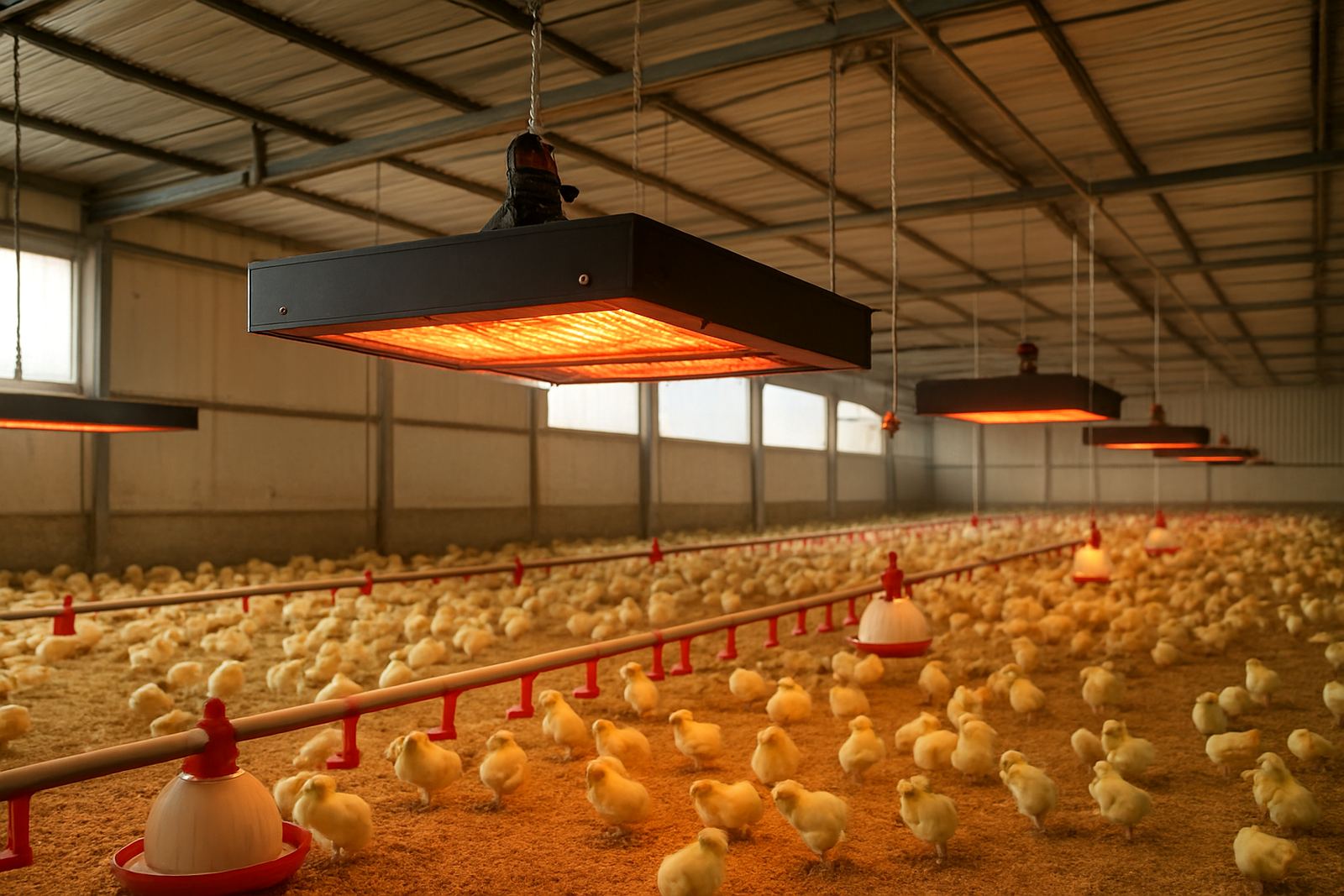
Gas brooders are used to give newly placed chicks the right floor-level warmth during the first stage of rearing. Instead of heating the whole house to one high temperature, the brooder gives focused heat where the birds are standing and moving, which helps them start feeding and drinking sooner. That matters in South African houses where night temperatures can swing sharply, and where a poor start can show up later as uneven growth.
These units are a good fit for larger poultry houses, broiler starter areas, rearing sheds and other spaces where heat needs to respond quickly to changing weather. They can be used in houses with litter floors, under brooding rings or in defined brooding zones. With correct placement and set-up, the flock gets a more even start and the house manager has better control over bird comfort.
Sizes, heat output and layout choices
Gas brooders are available in different heat outputs and mounting arrangements, depending on house size, bird numbers and roof height. In practical terms, the right choice depends on how many chicks are placed, how wide the house is, and how quickly the building loses heat at night. A bigger house with more air movement will normally need more units spaced carefully, rather than fewer high-output units pushed too hard.
- Suspended brooders for open floor areas and wider house layouts
- High-output units for large houses or cooler inland sites
- Lower-output units for smaller pens or tighter brooding zones
- Models with adjustable heat control for staged brooding
- Options for use with brood rings or partitioned starter areas
A well-planned layout matters as much as the brooder itself. If the units are too close, birds crowd under one point and the litter gets patchy. If they are too far apart, the chicks drift into cool spots and huddle. We look at house width, inlet positions and draught risk before finalising a layout, because every house behaves a bit differntly once the doors open and fans start running.
Where gas brooders suit best
Gas brooders are commonly chosen for commercial poultry houses where the operator wants quick heat-up times and practical control without waiting on a central hot-water or electric system. They suit farms in Gauteng, Limpopo, Mpumalanga, North West, Free State and KwaZulu-Natal, especially where night-time cold, wind or high ceiling heights make early heating more demanding.
They are also useful where the site has to manage power interruptions. Because the heat source is gas-fired, the brooding system can keep running as long as the gas supply and ignition arrangement are in order. That can be a real benefit on farms that still need to work around load-shedding or limited electrical supply to the house. In coastal areas, the equipment should be checked for corrosion risk and cleaned more often, since salty air and damp litter can shorten service life if maintenance is ignored.
- Broiler starter houses
- Pullet rearing houses
- Replacement layer rearing units
- New turnkey poultry projects
- Expansions on existing farms
Installation, gas supply and power needs
Correct installation is important for both bird performance and site safety. Gas brooders must be mounted at the right height, aligned properly and commissioned with the correct pressure and ignition settings. The gas line must be sized to suit the full number of brooders running at once, not only one unit on test. If the supply is under-sized, flame stability becomes poor and heating drops off when the house needs it most.
Most installations also need a basic electrical supply for ignition, control gear or monitoring, depending on the model selected. That means the site should plan for both gas and power, even though the heating source itself is gas. We normally check the house layout, gas bottle bank or reticulation point, regulator position, isolation valves and emergency shut-off arrangement before commissioning. Local municipal and fire-safety rules should also be followed, especially where gas storage is close to other buildings or the processing area.
For farms with multiple houses, it often makes sense to standardise on one brooder type across the site so the team learns one operating method. That helps with spares, training and fault finding, and it reduces confusion during a busy placement day.
Care, cleaning and service planning
Gas brooders need regular attention if you want steady heat and a long service life. Burners, jets, reflectors and guards should be cleaned as part of the normal house turnaround. Dust, feather build-up and damp litter can affect performance, and on some sites the first sign of trouble is uneven brood behaviour rather than a visible fault. A quick check before placement is much better than trying to sort a weak flame after chicks are in the house.
Service planning should include inspection of gas hoses, fittings, regulators and ignition parts. Any sign of cracking, rust, loose connections or poor flame shape should be dealt with before the next crop. In humid areas, corrosion can show up faster than expected, so the maintenance team should not leave brooders standing idle and dirty between cycles. We can help set up a simple maintenance programme that fits the farm's turnaround schedule and spare parts store.
- Clean burner points and guards after every flock turnaround
- Check gas pressure and flame pattern before placement
- Inspect hoses, seals and clamps for wear
- Keep spare igniters, jets and service parts on site
- Record any uneven heating or repeated shut-offs
What to confirm before you order
Before ordering gas brooders, it helps to confirm a few practical details so the equipment matches the house and the flock plan. We normally ask for house dimensions, bird numbers per cycle, ceiling height, insulation level and the local climate at the site. A house in Ermelo or Standerton will not behave the same as one near Richards Bay, so the heat load needs to be checked properly.
You should also know whether the site will use bulk gas, cylinder banks or another supply arrangement, and whether the current electrical system can support ignition and controls. If you are planning a new house, it is worth sharing the brooding layout at the same time as the ventilation plan, because both systems affect each other. For existing houses, photos and a rough sketch usually help us spot problems with draughts, door positions and mounting points before equipment is selected.
When supplied as part of a turnkey poultry project, gas brooders can be matched with feeders, drinkers, house layouts, training and maintenance support. That keeps the brooding system practical from day one, rather than leaving the team to guess how many units are needed or where they should sit. A good fit at the start saves a lot of chasing later on.
Key facts
| Heat source | LPG or other approved gas supply, depending on site set-up |
|---|---|
| Use case | Direct brooding heat for larger poultry houses and starter areas |
| Typical mounting | Suspended above litter or brooding zones |
| Control | Adjustable output and ignition arrangement, model dependent |
| Power need | Basic electrical supply may be required for ignition or controls |
| Support | Site planning, installation supervision, commissioning and training |