What a chilling tank does after processing
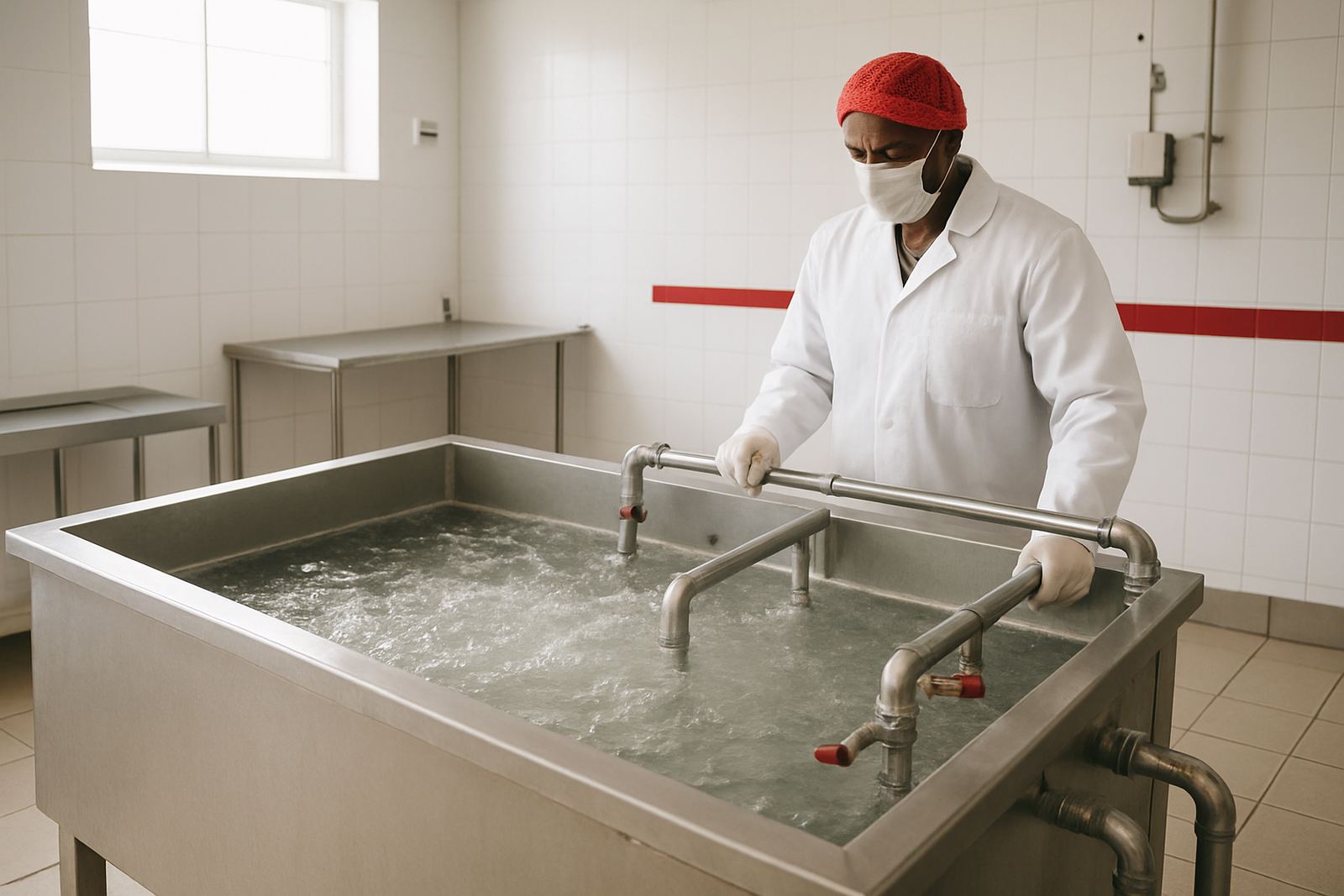
A chilling tank is used to reduce product temperature soon after slaughter or processing so the cold chain starts as early as possible. In poultry work, that means helping bring warm product down to a safe holding range before grading, packing or moving into a cold room. In meat rooms it can also assist with pre-cooling smaller product batches where space and time are tight.
For farms and abattoir setups around Gauteng, Limpopo, Mpumalanga and coastal areas, the main job is control. Warm rooms, interruptions from load-shedding and busy processing shifts can all push temperatures around, so the tank must cool evenly and be easy to clean. If the unit is fitted correctly, it becomes part of the daily workflow instead of a bottleneck.
Available sizes and build options
Chilling tanks are supplied in a range of capacities to suit batch size and available floor area. Smaller units are useful for training facilities, niche poultry rooms and expansion phases, while larger tanks suit higher throughput where product flow must keep moving. Typical build options include stainless steel contact surfaces, insulated sides, drain points, and lids or covers where required.
- Small batch tanks for limited floor space and lower daily throughput
- Medium tanks for grower-to-market operations and smaller processing rooms
- Large tanks for continuous use in abattoir and poultry project setups
- Single-chamber or multi-chamber layouts, depending on process flow
- Manual fill systems or pumped circulation, based on site water and control needs
We also look at the room itself. A tank that fits on paper may still be awkward if the door opening is too narrow, the floor is uneven or the drainage point is in the wrong place. That is why the house or room layout matters as much as the equipment size.
Where chilling tanks suit best
These units are commonly used in poultry processing rooms, on-farm abattoirs, portioning areas and small-scale expansion projects. They are also useful where product must be held before further handling, especially if the cold room is some distance away or loads are moved in stages. In humid coastal conditions, a tank with proper drainage and stainless finishes will usually hold up better over time.
They suit sites in places like Boksburg, Middelburg, Polokwane, Rustenburg, Bloemfontein and Pietermaritzburg where trade volumes differ but the same basic issue remains: keep the product cold and keep the process moving. Municipal water quality, floor drainage and waste handling should all be checked before final placement.
- Poultry abattoirs and cut-up rooms
- Farmer-owned processing units
- Turnkey poultry project installations
- Expansion upgrades to existing plants
Installation, utilities and power planning
Installation starts with site planning, because the tank needs enough room for loading, cleaning and safe staff movement. Level flooring, nearby drainage and proper access for maintenance are important. If the unit is part of a new processing room fitout, the tank position should sit naturally between processing and packing areas so operators are not carrying product further than needed.
Power requirements depend on the selected chilling method and control package. Some units need single-phase supply for smaller motors and controls, while larger systems may require three-phase power. Where load-shedding is a regular concern, backup planning is worth doing early, especially if the tank supports daily dispatch. In some projects a standby generator or controlled staging plan is used so the product does not sit too long during outages.
If chilled water or added cooling support is required, we check pipe runs, pump sizing and service access before sign-off. Gas is not used on every unit, but where a refrigeration support system forms part of the setup, the gas line routing and cylinder or compressor location must be planned to suit local safety rules and service access.
Care, cleaning and servicing between shifts
Chilling tanks are easier to keep clean if the operator team works with a clear routine. Daily rinse-down, proper drain clearance and checking seals or fittings for wear all help prevent contamination build-up. In hot weather, leaving residue in the tank after a shift can cause smell and slime faster than many sites expect, so the cleaning schedule needs to be practical, not theoretical.
We usually advise regular checks on welds, drains, pump parts, valves and any temperature control equipment fitted to the unit. If the tank is connected to a larger processing line, maintenance should be timed around production so the plant does not sit idle. Our support team can assist with service intervals, spares and operator training, which saves trouble later on.
- Wash and sanitise after each production run
- Inspect drains, valves and seals weekly
- Check temperature readings against the process spec
- Service pumps, motors and control parts on a set programme
- Keep a spare parts list for common wear items
What to check before you place an order
Before ordering, you should confirm the daily throughput, batch size, available floor space and how product will move from the processing point to the tank. Also confirm whether you need a single tank or a grouped setup, and whether the site has enough water supply, drainage and electrical capacity. If the room is already built, bring measurements for door widths, ceiling height and access routes, because a unit can be excellent but still fail to fit through a passage.
It is also worth checking the local power situation, especially in areas where outages are frequent or voltage drops happen in the afternoons. A chilled system that looks fine on paper may need a different control layout once the real site conditions are known. We can assist with equipment selection, installation supervision, commissioning and operator training so the final setup works from day one, not only after a few adjustments.
If you are planning a new poultry project or upgrading an existing processing room, send the room size, target output and utility details first. That makes the recommendation sharper and avoids costly changes once the tank arrives.
Key facts
| Typical use | Temperature pull-down after processing, before cold room holding or packing |
|---|---|
| Construction | Stainless steel contact surfaces with cleanable drain detail |
| Capacity range | Small batch units through to larger processing room installations |
| Utilities | Electrical supply, water supply and drainage, with optional cooling support where required |
| Installation | Floor levelling, access clearance, utility tie-ins and commissioning |
| Support | Site planning, training, maintenance and spare parts supply |